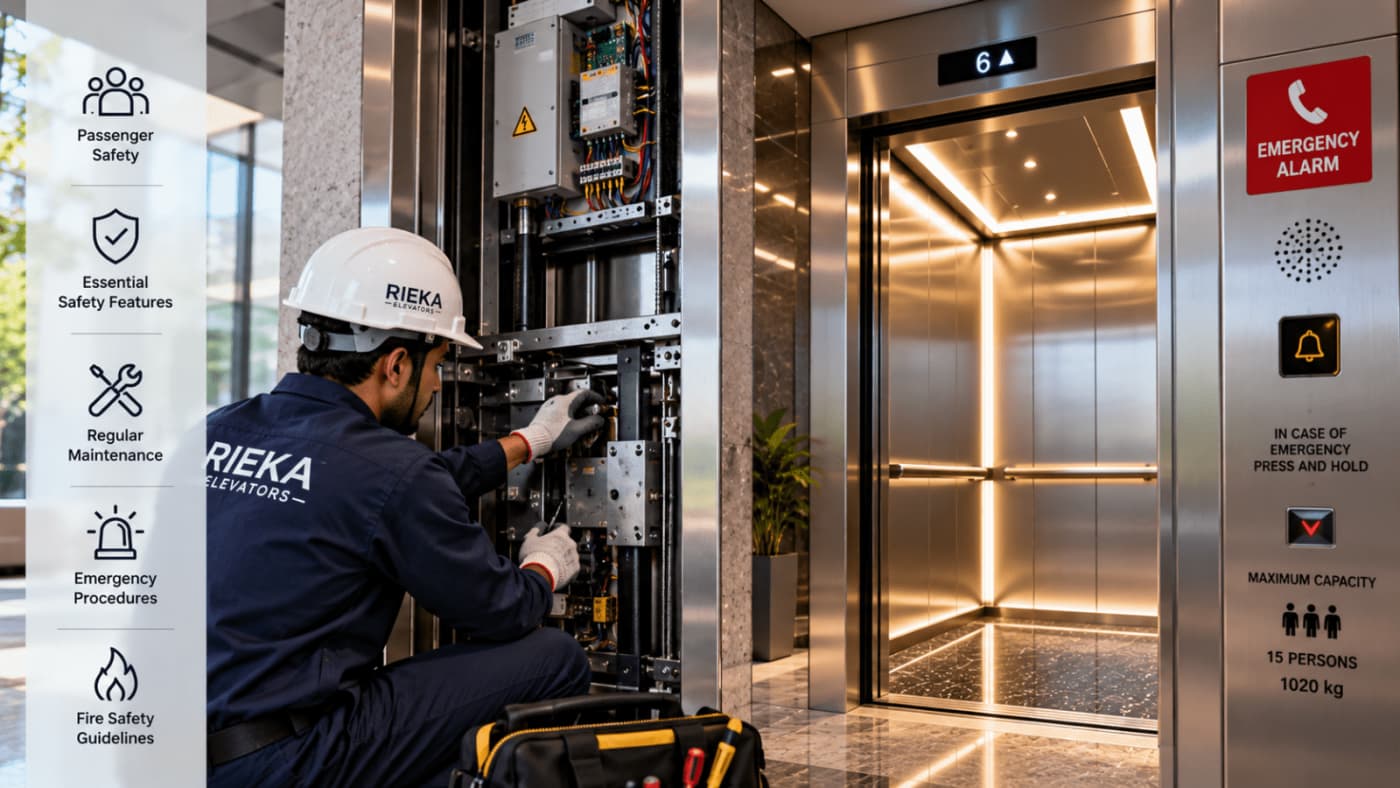
Elevator Safety in India: A Complete Guide for Passengers and Building Owners
Elevators have become an essential part of modern residential and commercial buildings. From apartments and shopping malls to hospitals, hotels and corporate offices, millions of people depend on lifts every day.
Although modern elevators are designed with multiple safety mechanisms, their safe operation depends on proper installation, regular maintenance, correct usage and awareness among passengers.
Understanding elevator safety in India is important for homeowners, building managers, facility operators and everyone who uses a lift.
A minor operational issue, an improperly maintained door system or an untrained rescue attempt can create unnecessary risks.
In this guide, we explain important elevator safety rules, common hazards, emergency procedures, maintenance practices and essential safety features that every building owner and passenger should understand.
1. Why Is Elevator Safety Important?
An elevator is a combination of mechanical, electrical and electronic systems that work together to transport passengers between floors.
These systems include:
- Elevator motor and drive system.
- Control panel and safety circuits.
- Landing doors and car doors.
- Door interlocks and safety sensors.
- Suspension ropes or belts, depending on the design.
- Braking and protective systems.
- Emergency lighting and communication equipment.
Every component must function correctly for the elevator to operate as intended.
Regular inspections and preventive maintenance help identify potential problems before they become serious operational or safety concerns.
Elevator safety is important because it helps:
- Protect passengers during normal operation.
- Reduce the likelihood of equipment-related incidents.
- Prevent door-related accidents.
- Support safe emergency response.
- Improve elevator reliability.
- Maintain accessibility for elderly people and passengers with disabilities.
According to the Bureau of Indian Standards (BIS), proper planning, installation and preventive maintenance by competent personnel are important for the safe functioning of lift installations.
2. Essential Elevator Safety Rules Every Passenger Should Follow
Elevator safety begins with everyday passenger behaviour.
Following a few simple precautions can help prevent common accidents and operational problems.
A. Do Not Overload the Elevator
Every elevator has a specified rated load and passenger capacity.
Overloading can affect normal operation and may activate the elevator's overload protection system.
Always check the displayed capacity and avoid entering an overloaded elevator.
B. Keep Clear of Closing Doors
Never place your hands, feet, bags or other objects between closing elevator doors.
Use the designated door-open button when necessary. Do not attempt to stop powered doors manually.
C. Allow Passengers to Exit First
Before entering an elevator, allow passengers inside to exit completely.
This reduces congestion near the entrance and makes boarding safer.
D. Supervise Children
Young children should always be accompanied by an adult when using an elevator.
Teach children not to play with elevator buttons, force doors open or run inside the cabin.
E. Be Careful When Entering and Exiting
Pay attention to the gap between the elevator car and landing floor.
If the elevator is not level with the floor, do not attempt to enter or exit. Inform building management or the maintenance team.
F. Do Not Jump or Play Inside the Elevator
Jumping, running or intentionally shaking the elevator cabin can disrupt normal operation and create unnecessary risks.
G. Keep Doors and Sensors Clear
Do not obstruct elevator doors or interfere with safety sensors.
Never attempt to tamper with door locks, emergency switches or other safety devices.
3. Important Safety Features in Modern Elevators
Modern elevators incorporate several safety systems designed to protect passengers and support safe operation.
Here are some important features building owners should understand.
A. Automatic Rescue Device (ARD)
An Automatic Rescue Device is designed to operate during certain failures or interruptions of the normal electrical supply.
Depending on the elevator configuration, it can move the elevator car to a designated landing and allow passengers to exit.
However, ARD functionality depends on the installed system and operating conditions.
It should not be considered a replacement for emergency communication, professional rescue arrangements or regular maintenance.
B. Door Interlock System
Door interlocks are important safety devices that prevent normal elevator movement unless the required landing door safety conditions are satisfied.
They help prevent the elevator from operating when a landing door is not properly secured.
Door interlocks must never be bypassed or tampered with.
C. Door Safety Sensors
Modern elevator doors may use non-contact safety sensors to detect passengers or objects in the doorway.
When an obstruction is detected, the door control system responds according to its design.
These sensors help reduce the possibility of passengers being struck by closing doors.
D. Overload Protection
Overload protection helps prevent elevator operation when the passenger or goods load exceeds the rated capacity.
Passengers should always respect the capacity indicated inside the cabin.
E. Emergency Alarm and Communication
An emergency alarm or communication facility allows passengers to request assistance if the elevator stops unexpectedly.
The building management should ensure that the communication arrangement is operational and that emergency contact information is available.
F. Emergency Lighting
Emergency lighting is designed to provide illumination inside the elevator if the normal power supply fails.
This can help passengers remain calm and use the available emergency communication system.
G. Braking and Protective Systems
Elevators incorporate braking and other protective mechanisms appropriate to their design.
These systems are engineered to support controlled operation and respond to specified abnormal conditions.
Their condition should be checked by qualified elevator professionals.
4. What Should You Do If You Get Trapped Inside an Elevator?
Getting trapped inside an elevator can be stressful, particularly during a power interruption or unexpected equipment fault.
However, panicking or attempting an unauthorised escape can create additional danger.
Follow these precautions:
Step 1: Stay Calm
Try to remain calm and reassure anyone else inside the elevator.
Do not jump, shake the cabin or try to force the doors open.
Step 2: Press the Emergency Alarm Button
Use the designated emergency alarm, telephone or communication facility inside the elevator.
Step 3: Contact Building Management
Inform the building security team, facility manager or elevator maintenance provider.
Clearly communicate the building location, elevator identification and the number of passengers trapped inside.
Step 4: Wait for Trained Assistance
Wait inside the elevator until trained personnel arrive and carry out the authorised rescue procedure.
Do not attempt to climb out through the ceiling hatch or force the doors open.
Step 5: Request Emergency Assistance When Necessary
If there is an immediate medical or other serious emergency, contact the appropriate emergency services.
Important: Never attempt to rescue trapped passengers by opening landing doors or entering the elevator shaft without the required training and authorisation.
Elevator rescue must be handled by competent personnel using the manufacturer's approved rescue procedure.
5. Elevator Safety During a Fire Emergency
Fire emergencies require special attention because normal elevator operation may be affected by fire, smoke, heat or electrical interruptions.
Passengers should understand the following precautions:
- Do not use an ordinary passenger elevator as an escape route during a fire alarm.
- Follow the building's fire evacuation plan.
- Use designated stairways and emergency exits.
- Never attempt to retrieve belongings by returning to an affected floor.
- Follow instructions from fire personnel and trained building emergency staff.
- Never assume that an elevator is safe to use simply because it is still operating.
Specially designed evacuation or firefighting lifts may be used in certain buildings under specific emergency procedures and authorised instructions.
However, ordinary passenger elevators should not be treated as general fire escape routes.
Building management should ensure that emergency evacuation instructions are clearly displayed and that fire drills are conducted according to the applicable building safety plan.
6. Elevator Maintenance: An Essential Part of Safety
Even a modern elevator requires regular inspection and maintenance.
Elevator components experience wear due to repeated operation. Dust, moisture, electrical fluctuations and mechanical deterioration can also affect equipment performance.
Preventive maintenance helps identify developing issues and maintain the elevator in a suitable operating condition.
Important maintenance checks include:
Door System Inspection
Check door operators, door locks, sensors and associated safety circuits.
Electrical System Inspection
Examine relevant electrical connections, protective devices and control panel components.
Motor and Drive Inspection
Check motor and drive operation, unusual vibrations, temperature and other signs of abnormal performance.
Rope or Belt Inspection
For elevators using ropes or belts, inspect their condition according to manufacturer instructions and applicable technical requirements.
Brake System Inspection
Inspect the braking system and associated components according to the equipment manufacturer's procedures.
Safety Device Testing
Verify the functioning of applicable safety devices and emergency arrangements.
Maintenance Records
Maintain proper records of inspections, servicing, repairs and recurring faults.
Maintenance should always be performed by competent and authorised elevator personnel. The maintenance schedule should follow manufacturer recommendations and applicable regulations.
7. Common Elevator Problems That Should Never Be Ignored
Some elevator problems may initially appear minor but can indicate the need for professional inspection.
Passengers and building managers should report the following issues:
A. Elevator Frequently Stops Between Floors
Repeated unexpected stops may indicate problems with electrical supply, controller operation, safety circuits or other components.
B. Doors Open or Close Irregularly
Door problems may involve sensors, door operators, locks or mechanical components.
C. Unusual Noise or Vibrations
Unexpected sounds or vibrations should be investigated by a qualified technician.
D. Elevator Does Not Stop Level With the Floor
Incorrect levelling can create a tripping hazard, especially for elderly passengers and wheelchair users.
E. Burning Smell or Visible Smoke
Stop using the elevator, keep passengers away and immediately notify building management and emergency services as appropriate.
Never attempt to investigate electrical or mechanical equipment yourself.
F. Water Entering the Elevator Shaft
Water accumulation in elevator shafts, pits or machinery spaces can create electrical and equipment-related hazards.
Report water ingress immediately and arrange a professional assessment before the elevator is returned to service.
Remember: Do not repeatedly reset or restart an elevator to hide a recurring fault. The underlying problem must be diagnosed and corrected.
8. Elevator Safety for Children, Elderly People and Persons with Disabilities
Elevator design should consider the needs of all passengers, not just able-bodied adults.
Safety for Children
- Always supervise young children.
- Prevent children from playing near elevator doors.
- Do not allow children to operate emergency controls unnecessarily.
- Teach children to wait for the elevator to stop before entering.
Safety for Elderly Passengers
- Allow sufficient time for entry and exit.
- Ensure the elevator is properly levelled with the landing.
- Keep cabin flooring clean and free from slippery materials.
- Ensure that emergency communication systems are accessible.
Safety for Persons with Disabilities
Accessible elevator design can improve independence and reduce unnecessary risks.
Useful design considerations include:
- Suitable door opening dimensions.
- Adequate cabin space for wheelchair users.
- Accessible control panel positioning.
- Clear visual and audible floor indications.
- Tactile or Braille controls where applicable.
- Suitable handrails and slip-resistant flooring.
- Appropriate door opening time.
- Accessible emergency communication facilities.
BIS has published IS 17900 (Part 7/Sec 4):2025, which addresses requirements for lifts intended for persons with disabilities.
Building owners and designers should consider applicable accessibility standards when planning or upgrading elevator installations.
9. Elevator Safety Standards and Regulations in India
Elevator safety in India involves technical standards as well as applicable state and local regulatory requirements.
The Bureau of Indian Standards has published the IS 17900 series covering important aspects of lift safety, design, planning, selection and maintenance.
Some important references include:
IS 17900 (Part 1):2022
Covers safety rules for lifts transporting persons and goods.
IS 17900 (Part 2):2022
Covers design rules, calculations, examinations and tests of lift components.
IS 17900 (Part 3/Sec 1)
Covers specifications for planning and selection of passenger, service, hospital, bed and stretcher lifts.
IS 17900 (Part 6)
Provides guidance on maintenance of lifts.
IS 17900 (Part 7/Sec 4):2025
Addresses requirements for lifts intended for persons with disabilities.
In addition to Indian Standards, different states and Union Territories have their own applicable lift laws, rules, licensing and inspection arrangements.
Building owners should verify the requirements applicable to their particular location and installation with the relevant state or local lift authority.
Following an appropriate technical standard and ensuring compliance with applicable local regulations are important parts of responsible elevator management.
10. Elevator Safety Checklist for Building Owners and Facility Managers
Building owners, resident welfare associations and facility managers should take an active role in elevator safety.
Here is a practical checklist:
- Ensure that the elevator has the required permissions and approvals under applicable regulations.
- Maintain a valid and appropriate maintenance arrangement.
- Ensure that servicing is carried out by competent personnel.
- Keep maintenance and inspection records.
- Verify that emergency alarms and communication facilities work.
- Ensure that passenger capacity notices are visible.
- Display emergency contact numbers.
- Keep unauthorised persons away from machine rooms and elevator shafts.
- Ensure that lift entrances and surrounding areas are adequately illuminated.
- Report unusual sounds, vibrations and door malfunctions.
- Keep water away from elevator equipment areas.
- Ensure that building occupants understand emergency procedures.
- Arrange appropriate evacuation drills and emergency response planning.
Elevator safety is not the responsibility of the maintenance company alone. Building management and passengers also play an important role.
11. How Rieka Elevators Supports Elevator Safety
At Rieka Elevators, we believe passenger safety should remain a priority throughout an elevator's life cycle.
From initial installation and commissioning to regular maintenance and modernization, every stage requires appropriate technical attention.
Our services include:
- New elevator installation.
- Residential and commercial elevator solutions.
- Elevator inspection and maintenance services.
- Annual Maintenance Contracts (AMC).
- Elevator repair and troubleshooting.
- Elevator modernization and upgrades.
- Control panel and door system upgrades.
- Technical support for elevator systems.
We focus on combining modern elevator technology with proper maintenance practices and customer support.
Whether you own a residential property, manage an apartment complex or operate a commercial building, our team can help you understand your elevator requirements and explore appropriate solutions.
Frequently Asked Questions About Elevator Safety
1. Is it safe to use an elevator during a power failure?
An elevator may continue operating through an appropriate backup power arrangement or an installed Automatic Rescue Device, depending on its configuration. Follow the elevator's instructions and do not attempt to interfere with its operation.
2. What should I do if an elevator gets stuck?
Stay calm, use the emergency alarm or communication system and contact building management. Wait for trained personnel. Never force the doors open or climb through the ceiling hatch.
3. Is an Automatic Rescue Device necessary?
An ARD is an important emergency feature in suitable elevator systems. Its design, installation and applicable requirements should be evaluated by a qualified elevator professional.
4. Can children use elevators alone?
Young children should be accompanied by an adult. They should be taught not to play with doors, buttons or emergency equipment.
5. Should elevators be used during a fire?
Ordinary passenger elevators should not be used as a means of fire escape. Follow the building's evacuation plan and use designated exits. Special evacuation or firefighting lifts must only be used according to authorised emergency procedures.
6. Why does an elevator stop between floors?
Possible causes include electrical interruptions, safety circuit activation, door-related faults or controller and mechanical problems. A qualified technician should investigate the actual cause.
7. Who is responsible for elevator safety in a residential building?
Responsibility is shared between building owners or management, the elevator maintenance provider and passengers. Each must follow their respective responsibilities, maintenance procedures and applicable regulations.
8. Does modern elevator technology improve passenger safety?
Modern elevator technology can include improved control systems, door sensors, emergency communication, monitoring and other protective features. However, technology cannot replace proper installation, inspection, maintenance and responsible passenger behaviour.
Conclusion
Elevator safety is a shared responsibility that requires proper engineering, regular maintenance, passenger awareness and effective emergency planning.
Whether an elevator is installed in a private residence, apartment complex, hospital or commercial building, its safety systems must be maintained and used correctly.
Never ignore recurring faults, never attempt unauthorised repairs and always ensure that emergency procedures are understood by building occupants.
A well-maintained elevator is not just about convenience. It is about protecting the people who depend on it every day.
Need professional elevator maintenance, repair or safety-related upgrades?
Contact Rieka Elevators to discuss your building's elevator requirements and explore suitable service solutions.
Rieka Elevators – Always Here for You.